Morocco’s Jewish heritage in morocco is one of the country’s most important and fascinating cultural stories. For centuries, Jewish communities lived in Moroccan cities and towns, contributing to trade, crafts, music, scholarship, diplomacy and everyday urban life. Today, travelers can still discover this history through the old mellahs, historic synagogues, Jewish cemeteries and restored communal buildings in places such as Fes, Marrakech, Essaouira, Rabat and Meknes.
A visit to Morocco’s Jewish heritage sites adds an important dimension to a Moroccan journey. This guide explains what a mellah was, how Jewish communities developed in Morocco, where to see the most significant surviving sites, and how travelers can respectfully include Jewish history in a Morocco itinerary.
What Is a Mellah in Morocco?
A mellah is the traditional name used for a Jewish quarter in many Moroccan cities. The word is closely associated with Jewish urban life in Morocco, although the exact origin of the term is debated.
The first major mellah is generally associated with Fes el-Jdid in the 15th century. The model was later established in other Moroccan cities, including Marrakech, Rabat and Essaouira. These neighborhoods could have their own synagogues, schools, markets, workshops, cemeteries and community institutions.
It is important not to think of every mellah simply as an equivalent of a European ghetto. The historical reality was more complicated. Jewish communities lived under the legal and social framework applied to non-Muslims in Islamic states, while also developing strong commercial, religious and communal institutions of their own. Conditions varied considerably according to the period, city and ruler.
For modern travelers, the mellah is best understood as a physical record of Jewish life in Morocco. Its streets, houses, balconies, doors, synagogues and cemeteries help explain how Jewish communities were integrated into Moroccan urban society while maintaining distinctive religious traditions.
A Brief History of Jews in Morocco
Jewish presence in Morocco goes back many centuries, long before the establishment of the modern Moroccan state. Jewish communities developed in different parts of the country, including cities, mountain settlements, oasis communities and Atlantic trading ports.
One of the most important changes came after the expulsion of Jews from Spain in 1492. Large numbers of Sephardic Jews, often known as the Megorashim, arrived in Morocco and settled alongside Jewish communities already living there. This created a rich mixture of Moroccan Jewish traditions and Iberian Sephardic customs.
Fes became one of the major centers of Jewish scholarship and commerce. Marrakech also developed a significant Jewish community, while Atlantic ports such as Essaouira became important centers for Jewish merchants involved in international trade.
Jewish merchants were particularly influential in Morocco’s commercial relationships with Europe. In Essaouira, for example, Jewish families became closely involved in the city’s trading economy during the 18th and 19th centuries.
By the 20th century, Morocco was home to one of the largest Jewish communities in the Muslim world. The community later declined dramatically as many Moroccan Jews emigrated, particularly during the decades following the establishment of Israel and Moroccan independence.
The result is a fascinating landscape for travelers: many Jewish communities have become much smaller, but the architectural and cultural traces of their presence remain.
Fes Mellah: One of the Most Important Jewish Heritage Sites
Fes tours and cultural journeys are an excellent choice for travelers interested in Jewish history because the city combines a historic mellah with one of Morocco’s most important medieval urban landscapes.
The Mellah of Fes is located in Fes el-Jdid, close to the Royal Palace. It was established during the Marinid period in the 15th century and is widely regarded as the first officially established mellah in Morocco.
Its location is significant. Unlike the ancient medina of Fes el-Bali, Fes el-Jdid was a royal city developed by the Marinid dynasty. The Jewish quarter became part of this new urban environment, close to the royal palace.
What to See in the Fes Mellah
One of the most interesting features is the architecture. Some houses have outward-facing balconies and windows, creating a noticeable contrast with traditional homes deeper inside the old medina.
The quarter also preserves important Jewish religious sites.
The Ibn Danan Synagogue is among the best-known Jewish monuments in Fes. Dating to the 17th century in its present historical form, it provides visitors with an opportunity to understand the religious and architectural traditions of Moroccan Jewry.
Another historically important synagogue is Slat al-Fassiyin, associated with the Jewish community of Fes and its distinctive religious traditions.
The Jewish cemetery is another essential part of the experience. Cemeteries are especially valuable for understanding Moroccan Jewish history because tombstones can preserve names, dates and family connections that are otherwise difficult to trace.
Practical Tip for Visiting Fes Mellah
Allow at least two to three hours if you want to combine the mellah with the Royal Palace area and other major Fes landmarks. A local guide can make a major difference because the historical significance of buildings is not always obvious from the street.
Morocco Best Tour’s 10 Days From Casablanca itinerary includes a Fes sightseeing day with the Royal Palace and the city’s Jewish district, making it a practical option for travelers who want to combine Jewish heritage with Morocco’s imperial cities and Sahara landscapes.
Marrakech Mellah: Jewish Heritage Near the Royal Quarter
The Marrakech Mellah is another essential stop for travelers interested in Jewish history.
The quarter developed during the Saadian period in the 16th century, near the royal palace complex. Its position close to the royal area reflects the importance of the community within the city’s political and commercial life.
Over time, the Marrakech Mellah became a densely populated neighborhood with homes, shops, synagogues and community facilities.
The Lazama Synagogue
One of the best-known Jewish sites in Marrakech is the Lazama Synagogue, also known as Slat al-Azama. The synagogue is associated with the Sephardic Jewish community that developed in Morocco after the arrival of Jews from Spain.
Its courtyard and decorative details provide an opportunity to see how Jewish religious architecture developed within the broader Moroccan architectural tradition.
The Miaara Jewish Cemetery
The Miaara Jewish Cemetery is one of the most memorable places to visit in Marrakech’s Jewish quarter. Its whitewashed tombs form a striking landscape and reflect the long history of the city’s Jewish community.
Visitors should treat the cemetery as a religious and memorial space rather than simply a tourist attraction. Dress modestly, follow local instructions and ask before photographing people or ceremonies.
Exploring the Mellah on Foot
The Marrakech Mellah is close to several major attractions, including the Bahia Palace, El Badi Palace and the souks around the medina. This makes it easy to incorporate into a full day of Marrakech sightseeing.
Look carefully at the streets and buildings rather than rushing between landmarks. Architectural details such as balconies, narrow passages, old commercial spaces and traditional doors can reveal how the neighborhood functioned as a living community.
Essaouira and Its Jewish Heritage
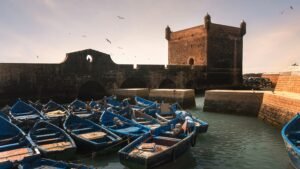
Essaouira offers a different perspective on Jewish heritage in Morocco. Unlike the inland imperial cities, Essaouira developed as an important Atlantic port and became a major center for international commerce.
Jewish merchants played a significant role in the city’s economic life, particularly during the 18th and 19th centuries. The Jewish community became deeply connected to trade between Morocco and European markets.
The old Mellah is therefore not just a residential quarter. It is part of the story of Essaouira’s development as a commercial port.
What Travelers Can See
When exploring Essaouira, look for historic buildings connected with former synagogues and Jewish communal life. The city’s Jewish cemetery outside the old city walls is another important heritage site.
Essaouira’s architecture makes the experience particularly interesting. The mellah contains buildings that reflect Moroccan, Andalusian and Atlantic influences, while surviving Jewish symbols and historic inscriptions provide clues to the community that once lived there.
For travelers staying in Marrakech, an Essaouira day trip is a convenient way to experience the Atlantic coast while adding another chapter to a Jewish heritage itinerary.
Rabat and the Jewish Quarter
Rabat also has an important Jewish history. Its mellah was established in the early 19th century during the reign of Sultan Moulay Slimane.
The Jewish community occupied an important place in the historic medina and in the city’s commercial life. Today, the surviving urban fabric provides another reminder that Jewish history was not limited to Fes and Marrakech.
Rabat is particularly convenient for travelers arriving from Casablanca because the two cities are relatively close. A journey that includes Casablanca, Rabat and Fes can therefore provide a broader picture of Jewish life in Morocco rather than focusing on one city alone.
The historic medina of Rabat is also valuable for understanding the wider multicultural development of the city. Jewish heritage is one part of a much larger story involving Arab, Amazigh, Andalusian, European and other influences.
Casablanca and Morocco’s Modern Jewish History
Casablanca’s Jewish history is closely connected with the city’s growth as Morocco’s major commercial center.
The Jewish quarter developed within and around the historic medina. Unlike some older mellahs, Casablanca’s Jewish district was not always physically separated from Muslim neighborhoods by strong walls or gates.
During the 19th and 20th centuries, Casablanca became increasingly connected to European commerce. Jewish merchants, professionals and artisans participated in this rapidly changing urban economy.
For travelers, Casablanca is useful for understanding the transition between traditional mellah life and modern Moroccan urban history.
If you are beginning your trip in Casablanca, a longer itinerary can connect the city’s history with Rabat, Fes, Marrakech and the Sahara. The 7 Days From Casablanca journey, for example, includes Casablanca, Rabat, Chefchaouen, Fes and the Merzouga desert, providing a practical framework for combining cultural sightseeing with a desert experience.
Jewish Cemeteries in Morocco: Why They Matter
Jewish cemeteries are among the most important surviving elements of Morocco’s Jewish heritage.
Unlike residential quarters, which naturally change over time, cemeteries preserve generations of names, family relationships and religious traditions. Tombstones can also help researchers and descendants reconstruct community histories.
Important Jewish cemeteries can be found in Fes, Marrakech, Essaouira and other Moroccan cities.
For travelers visiting these sites, respectful behavior is essential:
- Dress appropriately and modestly.
- Avoid climbing on graves or touching monuments unnecessarily.
- Ask before photographing ceremonies or people.
- Follow instructions from caretakers or local guides.
- Do not treat graves as ordinary sightseeing props.
- Allow extra time if you are visiting for genealogical or family-history research.
For people tracing Moroccan Jewish ancestry, a local guide with knowledge of the neighborhood can also help identify family names, old communal institutions and cemetery locations.
Moroccan Jewish Architecture and What to Look For
You do not need to enter a synagogue to notice Jewish heritage in Morocco. Much of the story is visible in the architecture.
In historic mellahs, look for:
Balconies and Windows
Traditional Jewish homes in some mellahs often have more outward-facing balconies and windows than many houses in older Muslim quarters of Moroccan medinas.
This difference developed from distinct community traditions and urban conditions.
Synagogue Courtyards
Many Moroccan synagogues are integrated into residential neighborhoods rather than standing as monumental buildings. Courtyards, tiled walls, carved plaster and painted wood can reflect the shared Moroccan architectural vocabulary found elsewhere in the country.
Hebrew Inscriptions and Symbols
Some buildings contain Hebrew inscriptions, Stars of David or other signs associated with Jewish life. These details can be easy to miss without a knowledgeable guide.
Cemeteries and Whitewashed Tombs
Jewish cemeteries often have distinctive whitewashed graves and Hebrew inscriptions. In Marrakech and Essaouira especially, cemetery visits can be an important part of understanding the scale and continuity of the former communities.
Jewish and Moroccan Culture: A Shared Heritage
One of the most interesting aspects of Jewish history in Morocco is how deeply Moroccan Jewish culture developed within the country itself.
Moroccan Jews spoke local languages and dialects, participated in regional trade and maintained food, music, clothing and architectural traditions that shared many characteristics with their Muslim neighbors.
At the same time, Jewish communities maintained religious practices, Hebrew traditions and communal institutions.
This combination is important when visiting the mellahs. They should not be viewed only as remnants of a vanished foreign community. Moroccan Jewish history is part of Morocco’s own national and cultural history.
The country today continues to recognize Jewish heritage as an important part of its historical identity. Restored synagogues, cemeteries, museums and heritage projects in different cities have helped preserve this memory for Moroccan families, visitors and members of the diaspora.
How to Plan a Jewish Heritage Trip in Morocco
You can explore Jewish heritage as a dedicated trip or incorporate it into a broader Morocco itinerary.
For a Short Trip
If you have only a few days, focus on Fes and Marrakech. Both cities offer historic mellahs alongside major Moroccan attractions.
Spend time in Fes exploring the Mellah, Royal Palace area, medina and historic religious monuments. In Marrakech, combine the Mellah and Jewish cemetery with the Bahia Palace, El Badi Palace and nearby souks.
For a Week or More
With seven to ten days, consider connecting Casablanca, Rabat, Fes, Marrakech and Essaouira. This gives you a much broader understanding of how Jewish communities developed in different environments.
Fes illustrates the importance of an imperial city and Jewish scholarship. Marrakech shows the relationship between the mellah and the royal quarter. Essaouira demonstrates the importance of Jewish merchants in Atlantic trade. Casablanca helps explain the transition into modern urban Morocco.
Combining Jewish Heritage With the Sahara
You do not have to choose between cultural history and the desert.
Morocco Best Tour’s longer itineraries connect Fes and Marrakech with the Sahara, allowing travelers to explore historic Jewish quarters before continuing through the Atlas Mountains toward Merzouga.
The 5 Days From Fes tour is particularly useful for travelers who want to start in Fes and continue toward the Sahara, with a route through the Middle Atlas, Midelt, Ziz Valley and Merzouga.
Practical Tips for Visiting Jewish Heritage Sites in Morocco
Hire a knowledgeable local guide. A mellah can look like an ordinary old neighborhood if you do not know what you are seeing. A good guide can explain former synagogues, cemetery traditions, architecture and the history of individual communities.
Check access before visiting. Synagogues, cemeteries and heritage buildings do not all have identical opening arrangements. Access can change according to restoration work, religious observances or local arrangements.
Dress respectfully. Modest clothing is appropriate for religious and historical sites.
Avoid assumptions about the past. Jewish-Muslim relations in Morocco changed across different periods and locations. A responsible historical explanation should acknowledge both cooperation and periods of restriction or tension.
Allow time for walking. Mellahs are usually best experienced slowly. Narrow streets, small courtyards and architectural details are easy to miss from a vehicle.
Consider your itinerary geographically. Fes and Marrakech are major stops on many Morocco tours, while Essaouira works naturally as a coastal extension from Marrakech. Casablanca and Rabat are particularly convenient at the beginning of a trip.
Respect living communities. Jewish heritage in Morocco is not only archaeological. Moroccan Jewish families and members of the diaspora continue to maintain relationships with these places. Treat synagogues, cemeteries and neighborhoods with the same respect you would show any active religious site.
Frequently Asked Questions About Jewish Heritage in Morocco
What is the most famous Jewish quarter in Morocco?
The Mellah of Fes is one of the country’s most historically significant Jewish quarters and is widely associated with the first established mellah in Morocco. Marrakech’s Mellah is also particularly important because of its connection to the Saadian royal city.
Is the Mellah in Fes worth visiting?
Yes. The Fes Mellah is especially worthwhile for travelers interested in history, architecture, genealogy and Moroccan religious heritage. Its location near the Royal Palace also makes it easy to combine with other Fes sightseeing.
Can tourists visit Jewish synagogues in Morocco?
Some historic synagogues are open to visitors, but access varies. Travelers should check locally and follow any instructions from caretakers. Synagogues remain religious spaces, so respectful behavior is essential.
Where can I see Jewish cemeteries in Morocco?
Jewish cemeteries can be found in several Moroccan cities, including Fes, Marrakech and Essaouira. They are important historical sites and should be visited respectfully.
What is a mellah?
A mellah is the traditional Moroccan term for a Jewish quarter. Mellahs developed in a number of Moroccan cities and often contained homes, shops, synagogues, schools and other community institutions.
When did many Moroccan Jews leave Morocco?
Large-scale emigration took place particularly during the decades after the establishment of Israel and Moroccan independence, with many Moroccan Jews moving to Israel, France, Canada and other countries. The timing and circumstances varied between families and communities.
Can I combine Jewish heritage with a Sahara Desert tour?
Absolutely. Fes and Marrakech are both major starting points for Morocco’s Sahara routes. A customized itinerary can include a mellah visit before continuing toward the Atlas Mountains and Merzouga.
Exploring Jewish heritage in Morocco is a chance to discover a part of the country that goes far beyond its famous palaces, medinas and desert landscapes. From the historic Mellah of Fes and Marrakech’s synagogues and cemetery to the trading history of Essaouira, these places reveal centuries of Moroccan Jewish life and its connection to the country’s wider culture. If you want to include Jewish heritage, historic medinas and the Sahara in one carefully planned journey, contact Morocco Best Tour to create a personalized Morocco itinerary around your interests.