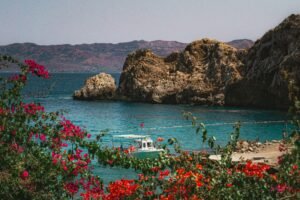
Tafraoute pink mountains are one of southern Morocco’s most distinctive landscapes, with enormous granite formations rising around the quiet town of Tafraoute in the Anti-Atlas. The rocks change from soft pink and rose tones to orange, red, and purple as the sunlight moves across the valley, creating a spectacular setting for photography, hiking, road trips, and cultural exploration.
If you are planning a visit, this guide explains what makes the landscape special, how to reach Tafraoute, the best viewpoints and attractions nearby, when to go, how long to stay, what to pack, and how to combine the town with a wider Morocco itinerary.
Where Are the Tafraoute Pink Mountains?
Tafraoute is a small mountain town in Morocco’s Anti-Atlas region, in the Souss-Massa area of southern Morocco. It sits at roughly 1,000–1,200 metres above sea level and is surrounded by granite mountains, rocky plateaus, palm groves, almond trees, and traditional Amazigh villages.
The landscape is very different from the snow-capped High Atlas around Marrakech. Instead of towering limestone peaks, Tafraoute is characterized by rounded granite boulders and rugged rock formations scattered across dry valleys.
The most famous scenery is around the Ameln Valley, where villages and cultivated areas sit beneath the rocky slopes. The combination of pink granite, green palm trees and almond orchards is particularly striking after winter rains and during the almond blossom season.
Tafraoute is also considerably quieter than Morocco’s major tourist destinations. That makes it a good choice for travelers who want mountain scenery without the crowds associated with places such as Marrakech or the more famous Atlas routes.
Why Are the Mountains Around Tafraoute Pink?
The phrase “pink mountains” is commonly used to describe the granite landscape surrounding Tafraoute. The rock itself is naturally pink, rose, reddish, grey, or orange depending on the formation and the light.
Sunrise and sunset are particularly important if photography is a priority. Low-angle sunlight emphasizes the texture of the granite and can make the rocks appear much warmer than they do around midday. The official regional tourism information also highlights the unusual colors and shapes of Tafraoute’s granite landscape.
The terrain was shaped over a very long geological period. Weathering gradually rounded and fractured the granite, producing the enormous smooth boulders and unusual formations that are now characteristic of the area.
This is why Tafraoute feels different from many other Moroccan mountain destinations. You are not simply looking at a mountain range; you are exploring an enormous natural landscape of sculpted granite.
The Best Things to See Around Tafraoute
A visit to Tafraoute should not be limited to the town itself. Several attractions are spread through the surrounding valleys and rocky countryside.
1. The Pink Granite Landscape
The natural granite formations are the main attraction. You will find huge boulders balanced across hillsides, smooth rock faces, narrow valleys and panoramic viewpoints around the town.
Allow time to stop frequently rather than treating Tafraoute as a destination you simply drive through. Some of the best photographs come from unexpected roadside viewpoints.
For hikers and photographers, early morning and late afternoon are especially rewarding because the softer light reveals more detail in the rock.
2. The Painted Rocks of Tafraoute
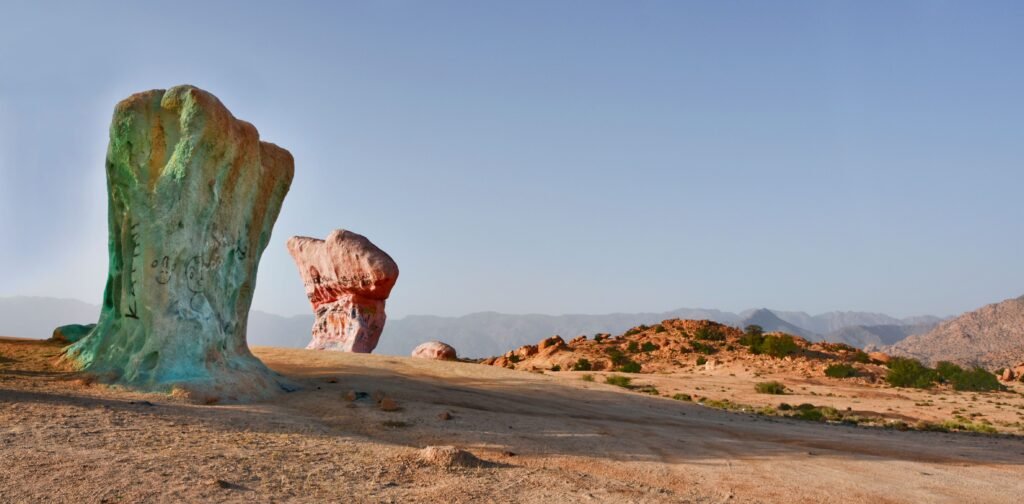
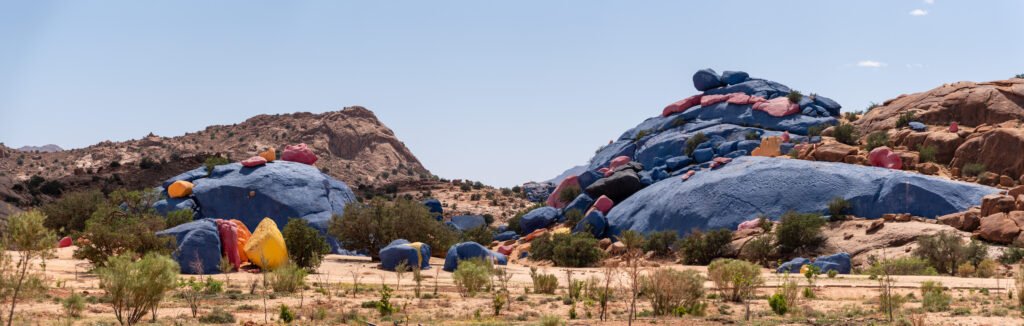
The Painted Rocks are one of the strangest sights in the region.
In 1984, Belgian artist Jean Vérame created a large-scale land-art installation by painting huge granite boulders near Tafraoute. The rocks were covered mainly in vivid blue, along with other colors, creating an unusual contrast with the surrounding natural landscape.
The colors have weathered over the decades, so the appearance today is different from the original installation. Some visitors love the surreal contrast; others prefer the untouched granite landscape.
Either way, the Painted Rocks are worth seeing because they are unlike almost anything else on a Morocco itinerary.
The site is accessible by road and can be combined with other attractions around Tafraoute. If you are driving independently, check the road and track conditions locally before setting out, particularly after heavy rain.
3. Aguerd Oudad and Napoleon’s Hat
Aguerd Oudad is a traditional village south of Tafraoute, famous for a dramatic granite formation commonly known to visitors as Napoleon’s Hat.
The rock gets its nickname from its distinctive silhouette. The village itself is also worth exploring because it provides a closer look at the relationship between Amazigh settlements and the surrounding mountain landscape.
Take your time here. Rather than photographing the rock and immediately leaving, walk around the village and observe the traditional architecture, palm groves and granite formations.
4. The Ameln Valley
The Ameln Valley is arguably the most rewarding part of the Tafraoute region for travelers who want scenery combined with local culture.
Villages are scattered across the valley beneath the mountains, while almond trees, argan trees and cultivated land add patches of greenery to an otherwise dry landscape. The valley is particularly beautiful during almond blossom season.
A private vehicle is useful because the villages and viewpoints are spread out. You can stop for photographs, short walks and tea without having to follow a rigid sightseeing schedule.
If you are interested in local architecture and traditional rural life, consider spending at least part of a day exploring the valley rather than treating it as a quick drive.
5. Aït Mansour Gorge
Aït Mansour is another major attraction near Tafraoute.
The gorge provides a dramatic contrast to the open granite landscape. Narrow rock walls surround sections of the route, while palm trees and small settlements appear in the valley floor.
The journey is more about the landscape than ticking off a single viewpoint. Roads can be winding and conditions vary, so give yourself plenty of time and avoid planning the excursion too tightly.
Aït Mansour works particularly well as part of a full-day private excursion from Tafraoute.
Best Time to Visit the Tafraoute Pink Mountains
The best time depends on what you want to experience.
February: Best for Almond Blossoms
February is the standout month if you want to combine the Tafraoute pink mountains with almond blossoms.
The Ameln Valley is an important almond-growing area, and flowering trees can create a beautiful contrast against the granite landscape. Exact flowering dates vary from year to year depending on winter conditions, so travelers interested specifically in the blossoms should check locally before finalizing their dates.
February can also be a busier period, so accommodation should be arranged ahead of time.
March to May: Excellent for Outdoor Exploration
Spring offers comfortable conditions for walking and exploring the valleys.
The landscape can look greener after seasonal rainfall, while temperatures are generally more pleasant than during the summer. This is a good period for travelers who want to combine sightseeing with short hikes.
October and November: Great for Hiking and Photography
Autumn is another excellent choice.
The days are generally more comfortable for walking than the hottest summer months, and the low-angle sunlight can be fantastic for landscape photography.
If your priority is hiking rather than almond blossom, October and November are strong alternatives to February.
June to September: Be Careful With the Heat
Summer can be very hot in the valleys, with temperatures potentially rising well above 35°C.
If you visit during this period, plan outdoor activities for early morning or late afternoon. Carry enough water, use sun protection and avoid starting a long hike in the middle of the day.
December and January: Quiet Mountain Scenery
Winter can be peaceful and atmospheric. Nights can be cold, but the cooler conditions can make daytime exploration comfortable.
If you are mainly interested in the rocks and landscapes rather than almond blossoms, winter can offer a quieter experience.
How to Get to Tafraoute
From Agadir
Agadir is the most practical major starting point for many travelers.
Tafraoute is roughly 160 kilometres from Agadir by road, although the journey takes significantly longer than the distance might suggest because of winding mountain roads. Regional tourism information puts the journey at around three hours, while other travel guides recommend allowing approximately four hours depending on road conditions and stops.
A private vehicle is particularly useful because many of the attractions around Tafraoute are outside the town.
The usual approach is through Tiznit and then into the Anti-Atlas. The road itself is part of the experience, with mountain scenery appearing as you leave the flatter coastal and agricultural landscapes.
From Tiznit
Tiznit is another useful base or stopover.
The journey between Tiznit and Tafraoute takes you deeper into the Anti-Atlas and provides a dramatic change in scenery.
If you are planning a southern Morocco road trip, you can combine Tiznit, Tafraoute and the Atlantic coast around Mirleft or Sidi Ifni into a longer route.
From Marrakech
Tafraoute is possible from Marrakech, but it is not an ideal day trip.
The journey is long enough that attempting to visit Tafraoute and return to Marrakech on the same day would leave little time to explore the destination itself.
Instead, consider incorporating Tafraoute into a multi-day southern Morocco itinerary. If your wider trip already includes Marrakech, Sahara landscapes and Ouarzazate, a customized route can make much more sense than treating Tafraoute as an isolated excursion.
For travelers beginning in Marrakech, Morocco Best Tour offers several longer itineraries, including the 12 Days From Marrakech tour, which travels through major southern and central Moroccan landscapes before continuing toward Fes and Marrakech.
How Many Days Do You Need in Tafraoute?
For a first visit, two nights is a good minimum if your schedule allows it.
One full day can cover the main granite landscape, Painted Rocks, Aguerd Oudad and part of the Ameln Valley. A second day allows you to explore Aït Mansour or take a longer walk without rushing.
A simple two-night plan could look like this:
Day 1: Arrive in Tafraoute, explore the town and surrounding viewpoints, then enjoy sunset over the granite formations.
Day 2: Visit the Painted Rocks and Aguerd Oudad in the morning, explore the Ameln Valley during the day, and continue toward Aït Mansour if road and weather conditions are suitable.
Day 3: Have a relaxed breakfast and continue toward your next destination, such as Tiznit, the Atlantic coast or Agadir.
If you only have one night, prioritize the Ameln Valley, the granite formations and the Painted Rocks.
What to Do in Tafraoute Beyond the Mountains
The rocks are the main reason many travelers arrive, but the town and surrounding communities add another layer to the experience.
Visit the Local Souk
Tafraoute is a working market town rather than a resort built purely around tourism.
A local souk is a good opportunity to see everyday commerce and buy regional products. Depending on the day, you may find food, household goods, clothing, crafts and agricultural products.
Try Local Almond and Argan Products
The region is associated with almonds and argan products.
Look for products such as almonds, argan oil and amlou, a traditional spread made with ingredients including almonds, argan oil and honey.
If you buy food products, choose established local shops and check packaging and labeling if you intend to take them home.
Meet Amazigh Communities
Tafraoute lies in an area with a strong Amazigh cultural identity.
Travelers should approach villages respectfully. Ask before photographing people, particularly older residents and anyone working or conducting daily activities.
A local guide can also add useful cultural context that you will not get from simply driving through the valley.
Is Tafraoute Good for Hiking?
Yes, but you should choose your walks carefully.
The surrounding Anti-Atlas terrain offers excellent opportunities for walking, photography and exploration, but not every route is clearly marked. Some trails cross rocky terrain where navigation can become difficult.
For short walks near populated areas, sensible footwear, water and sun protection may be enough. For longer or less familiar routes, a local guide is a much better option.
Avoid assuming that a short distance on a map means an easy hike. Granite terrain can be uneven, and summer heat can significantly increase the difficulty.
If hiking is a major priority, tell your tour operator in advance so the itinerary can include appropriate walking opportunities rather than simply driving between viewpoints.
What Should You Pack for Tafraoute?
The right packing list depends heavily on the season, but these items are useful:
- Comfortable walking shoes with good grip
- A refillable water bottle
- Sun cream and sunglasses
- A hat or other sun protection
- Light layers for daytime changes in temperature
- A warm layer for cool evenings
- A small daypack
- Camera or smartphone with extra battery power
- Offline maps if you plan to explore independently
- Cash for small purchases and rural stops
- Modest, comfortable clothing suitable for villages and local communities
In summer, water and sun protection become especially important. In winter, bring a warmer jacket because temperatures can fall significantly after sunset.
Photography Tips for the Pink Granite Mountains
Tafraoute is one of Morocco’s best destinations for landscape photography, but timing matters.
Shoot around sunrise: Early light can create warm tones across the granite while avoiding the harsh contrast of midday.
Return for sunset: The rocks can become noticeably warmer in color as the sun drops.
Include scale: A person, tree, village or vehicle in the frame helps communicate how enormous some of the boulders are.
Use the valley: Do not photograph only individual rocks. Wide compositions showing the granite, villages, palms and mountains provide a better sense of place.
Avoid midday when possible: Strong overhead sunlight tends to flatten the texture of the rocks.
For the Painted Rocks, experiment with wider compositions that show the contrast between the artificial colors and the natural granite surroundings.
Can You Visit Tafraoute as Part of a Longer Morocco Tour?
Absolutely, and this is often the best way to experience it.
Tafraoute works particularly well in a southern Morocco itinerary that includes Agadir, Tiznit, the Anti-Atlas and the Atlantic coast. It can also be connected with a wider route toward Ouarzazate and the Sahara, although the distances require careful planning.
Morocco Best Tour specializes in private and personalized Moroccan journeys, allowing travelers to request routes based on their interests rather than following a fixed itinerary.
For travelers already exploring the desert side of southern Morocco, the company’s 3 Days From Ouarzazate tour is another existing itinerary to consider as part of a broader trip.
The important point is that Tafraoute should be treated as a destination in its own right. It is better to allow enough time for the Anti-Atlas than to squeeze it between long driving days.
Practical Tips for Visiting Tafraoute
Start Early
Early starts are useful for photography, hiking and avoiding the hottest part of the day.
Allow Extra Driving Time
Mountain roads can be slow. Do not plan your itinerary using distance alone.
Keep Cash Available
Small shops, rural stops and local services may not always accept cards.
Do Not Rely Entirely on Mobile Coverage
Download important maps and directions before leaving your accommodation, particularly if you plan to explore remote areas.
Check Conditions Before Remote Excursions
Ask locally about road conditions before heading toward less accessible valleys or tracks, especially after rain.
Respect the Landscape
Do not climb fragile formations unnecessarily, leave rubbish behind, or disturb painted or archaeological sites.
Hire a Local Guide for Deeper Exploration
A guide can make a major difference if you want to understand the villages, Amazigh culture, rock art or less obvious viewpoints around Tafraoute.
Tafraoute Pink Mountains FAQ
Are the Tafraoute mountains really pink?
Yes. The area is famous for naturally pink and reddish granite formations. Their appearance changes with weather, season and especially the angle of sunlight.
Where are the Painted Rocks in Tafraoute?
The Painted Rocks are located a few kilometres south of Tafraoute around the Aguerd Oudad area. The installation was created by Belgian artist Jean Vérame in the 1980s.
What is the best month to visit Tafraoute?
February is particularly attractive for almond blossom, while March to May and October to November are good periods for comfortable outdoor exploration. Summer can be very hot.
How far is Tafraoute from Agadir?
Tafraoute is roughly 160–165 km from Agadir by road, with travel time generally around three to four hours depending on the route, stops and road conditions.
Is Tafraoute worth visiting?
Yes, especially if you enjoy dramatic landscapes, photography, hiking, Amazigh culture and quieter destinations. The combination of pink granite, the Ameln Valley, Painted Rocks and nearby gorges makes Tafraoute one of southern Morocco’s most distinctive mountain destinations.
How long should I stay in Tafraoute?
Two nights is a comfortable minimum for seeing the main attractions without rushing. One night is possible if you are short on time, while three nights gives you more flexibility for hiking and exploring the surrounding valleys.
Can Morocco Best Tour arrange a trip to Tafraoute?
Morocco Best Tour provides private and customized Morocco travel experiences and can tailor itineraries around travelers’ interests. If Tafraoute is a priority, it is best to request it when planning your route so enough time can be allocated for the Anti-Atlas.
The Tafraoute pink mountains offer a completely different side of Morocco, combining rose-colored granite, Amazigh villages, almond orchards, unusual rock formations and quiet Anti-Atlas scenery. For the best experience, allow at least two nights, visit during the cooler months or February almond blossom season, and explore beyond the town itself. If you want to add Tafraoute to a private southern Morocco road trip, contact Morocco Best Tour to create a personalized itinerary around your travel dates and interests.