Amazigh clothing is one of the most distinctive expressions of Morocco’s cultural heritage. For travelers, seeing Amazigh dress in a mountain village, desert community, wedding celebration, or traditional market offers more than a photo opportunity: the fabrics, colors, jewelry, weaving techniques, and ways garments are worn can reveal a great deal about regional identity and everyday life.
In this guide, you’ll learn what Amazigh clothing looks like, how styles differ across Morocco, what traditional garments and jewelry mean, where travelers can see them, how to shop for authentic pieces, and how to dress respectfully when visiting Amazigh communities.
What Is Amazigh Clothing?
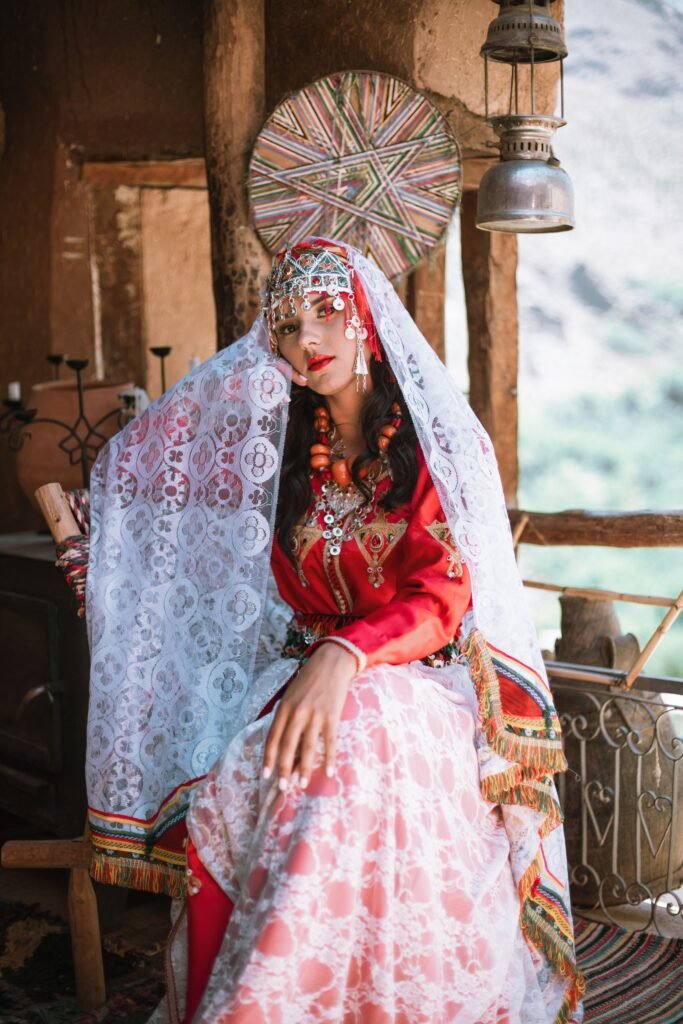
Amazigh clothing refers to the traditional garments, textiles, accessories, and forms of personal adornment associated with Morocco’s Amazigh communities. The word Amazigh is widely used today to describe the Indigenous peoples and cultures of North Africa, while “Berber” is an older term that is still commonly encountered in tourism and historical sources.
There is no single Amazigh costume. Morocco’s Amazigh communities are spread across different regions, including the Rif, Middle Atlas, High Atlas, Souss, Anti-Atlas, and southeastern desert areas. Climate, local traditions, available materials, community identity, and ceremonial customs have all influenced the way people dress.
This regional diversity is particularly important for travelers. A garment seen in the High Atlas may look quite different from clothing worn in the Rif or southern Morocco. Even colors, patterns, weaving techniques, and jewelry can vary considerably.
Morocco’s National Tourist Office also highlights the continuing importance of traditional clothing and Amazigh craftsmanship, including handmade textiles, carpets, and jewelry.
Why Is Amazigh Clothing Important in Moroccan Culture?
Traditional clothing is not simply about appearance. In many Amazigh communities, clothing and adornment can communicate identity, family traditions, social occasions, regional belonging, and craftsmanship.
Textiles are particularly important because weaving has historically been an important household craft. Handmade fabrics could be practical, providing warmth or protection from the climate, while decorative elements could give garments a distinctive regional character.
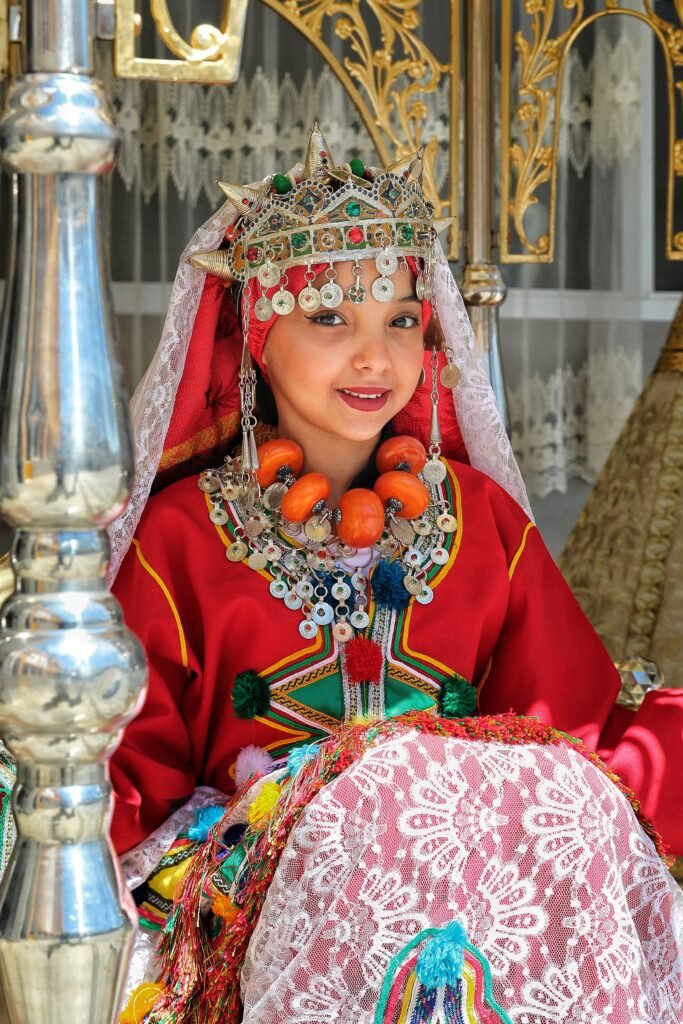
Jewelry is another major part of Amazigh visual culture. Silver ornaments, fibulas, necklaces, earrings, headpieces, and other accessories can be highly elaborate. Museums and cultural institutions have documented the relationship between Amazigh adornment, identity, protection, memory, and community traditions.
For visitors, this means that an Amazigh garment or piece of jewelry should not automatically be treated as a simple souvenir. It may represent a particular regional tradition or have a ceremonial history behind it.
Main Types of Amazigh Clothing Travelers May See
There is considerable variation between communities, but several garments and textile traditions are especially useful to recognize when traveling through Morocco.
1. The Djellaba
The djellaba is one of Morocco’s best-known traditional garments. It is a long robe, normally recognizable by its hood, and it is worn by both men and women in different forms.
The djellaba is not exclusively Amazigh. It is part of wider Moroccan dress culture and has been adapted over time in different communities. Traditional examples can be made from heavier wool for colder weather or lighter fabrics for warmer conditions.
The hood is particularly practical in Morocco’s varied climate. In mountainous areas, a heavier djellaba can provide warmth, while lighter versions are suitable for everyday use.
The Metropolitan Museum of Art describes the Moroccan jellaba as a common item of male dress and notes that its fabric weight varies according to the season.
For travelers, a lightweight djellaba can also be a practical garment during cooler evenings, particularly when visiting the mountains or desert after sunset.
2. Handira
The handira is a traditional woven woolen textile particularly associated with Amazigh communities in Morocco’s mountainous regions.
It is often recognized by its woolen construction and decorative details, including rows of small ornaments or sequins in some examples. Handiras have strong associations with women’s textile traditions and are particularly well known in connection with weddings and ceremonial dress.
Today, travelers may encounter handiras as wall decorations, blankets, throws, or fashion pieces. However, an antique or traditionally made handira can have considerably more cultural and artistic significance than a modern decorative reproduction.
If you are interested in buying one, ask the seller where it was made, what materials were used, and whether it is handmade.
3. Tamelhaft and Draped Women’s Garments
In parts of southern Morocco and the Atlas regions, women have traditionally worn large rectangular pieces of woven fabric wrapped around the body.
Names and styles vary by community, so it is better not to assume that every draped garment belongs to exactly the same tradition. Some are worn for everyday purposes, while others are associated with ceremonies or specific regional identities.
For travelers, the important point is that Amazigh women’s dress is often built around wrapping, pinning, layering, and accessorizing textiles rather than relying on a single fitted garment.
4. Mendil and Fouta
In northern Morocco, particularly in the Rif region, travelers may encounter distinctive woven textiles and wrapped garments associated with local women’s dress.
Striped or patterned textiles can be worn around the waist or body, while head coverings and other accessories complete the outfit. Colors and patterns can help distinguish regional styles.
These garments are a good reminder that “Amazigh clothing” is not one fixed fashion category. Morocco’s different Amazigh regions have their own textile vocabulary and traditions.
Amazigh Jewelry: More Than Decoration
One of the easiest ways for travelers to recognize Amazigh cultural traditions is through jewelry.
Amazigh jewelry in Morocco is particularly famous for silverwork. Large necklaces, earrings, bracelets, fibulas, pendants, and other ornaments can be visually striking and may be combined with colored stones, enamel, beads, or other materials.
A particularly important item is the fibula, a large decorative fastening used to hold clothing or fabric in place. In addition to its practical function, the fibula can become a major decorative feature of traditional dress.
Amazigh jewelry has also been documented in Moroccan museum collections, including regional rural jewelry and bridal adornments. The Moroccan National Tourist Office notes that Marrakech and southern cities such as Agadir, Tiznit, Goulimine, Essaouira, and Taroudant are associated with Amazigh jewelry and traditional craftsmanship.
What Do Amazigh Jewelry Symbols Mean?
You will often see geometric shapes, crosses, triangles, diamonds, hands, circles, and other motifs in Amazigh textiles and jewelry.
However, travelers should be cautious about simplified explanations such as “this symbol always means X.” Meanings can change according to region, community, period, and individual interpretation.
Some decorative traditions relate to identity, protection, fertility, nature, family, or spiritual beliefs. Museum research also emphasizes that adornment in Amazigh culture can express belonging and connections between the individual, community, and natural world.
If a local artisan explains the meaning of a particular motif, that local explanation is often more valuable than a generic interpretation found on a souvenir label.
Regional Differences in Amazigh Clothing
Morocco’s Amazigh population is geographically diverse, and clothing reflects that diversity.
Rif Mountains
The Rif in northern Morocco has its own distinctive textile and clothing traditions. Women’s garments can feature colorful woven fabrics, striped patterns, and traditional head coverings.
If your itinerary includes northern destinations such as Chefchaouen or the surrounding Rif, look beyond the blue-painted streets and pay attention to local textile traditions.
Middle Atlas
The Middle Atlas is home to important Amazigh communities and strong wool-weaving traditions.
The region’s colder mountain climate has influenced the use of woolen garments and textiles. Travelers may encounter woven blankets, capes, rugs, and other handmade pieces.
If you are interested in traditional weaving, a visit to rural areas with a knowledgeable local guide can provide much more context than shopping alone.
High Atlas
The High Atlas contains numerous Amazigh villages where traditional crafts remain part of local cultural life.
Clothing here has historically needed to cope with significant changes in temperature and mountainous conditions. Woolen textiles, layered garments, wraps, and practical footwear all have a place in mountain life.
A visit to an Atlas village can therefore provide an opportunity to see traditional clothing in its real cultural setting rather than only in a shop or museum.
Souss and Anti-Atlas
Southern Morocco has particularly strong Amazigh cultural traditions. Cities and towns such as Taroudant and Tiznit are well known for crafts and jewelry.
The Moroccan National Tourist Office specifically describes Taroudant as an important center for Amazigh jewelry and traditional crafts.
If you are traveling through southern Morocco, local souks can be excellent places to explore handmade silver jewelry, textiles, leather goods, and other crafts.
Southeastern Morocco and the Sahara
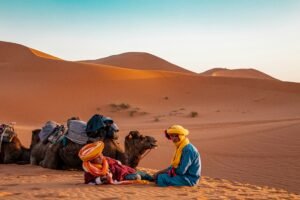
Around the southeastern oases and the Merzouga region, visitors can encounter communities with diverse cultural backgrounds and traditions, including Amazigh heritage.
A Sahara itinerary can provide opportunities to learn about local clothing, music, jewelry, weaving, and nomadic traditions. Morocco Best Tour’s desert itineraries include visits to local communities around Merzouga and opportunities to experience the region beyond the dunes. For example, the 5 Days From Fes to Marrakech desert tour includes time around Merzouga, a visit with a nomadic family, and an exploration of local cultural traditions.
Where Can Travelers See Amazigh Clothing in Morocco?
You do not need to attend a special festival to encounter Amazigh clothing.
Traditional Souks
Souks in Marrakech, Taroudant, Tiznit, Ouarzazate, and other Moroccan cities can contain textiles, jewelry, clothing, carpets, and handmade accessories.
However, not everything labeled “Berber” or “Amazigh” in a tourist market is necessarily old or handmade. Some products are modern reproductions made specifically for visitors.
Ask questions before buying:
- Where was the item made?
- Is it handmade?
- What material is it made from?
- Which region is it from?
- Is the design traditional or contemporary?
- Was it made locally?
- Is the jewelry silver or another metal?
A good seller should be able to explain the product rather than simply telling you that it is “authentic.”
Museums in Marrakech
Travelers interested in Amazigh clothing and adornment can also visit museums.
The Berber Museum in Marrakech, located within the Jardin Majorelle complex, presents Amazigh artifacts including ornaments, jewelry, costumes, and ceremonial objects.
A museum visit is particularly useful before shopping because it gives you an opportunity to understand regional styles and craftsmanship without the pressure of making a purchase.
How to Experience Amazigh Culture Respectfully
If your journey takes you into an Amazigh village or rural community, cultural sensitivity matters.
Ask Before Photographing People
Always ask permission before taking a close-up photograph of someone, especially if you are interested in photographing their clothing or jewelry.
A respectful “May I take a photo?” is much better than photographing someone without their knowledge.
Do Not Treat Traditional Dress as a Costume
If you are invited to wear traditional clothing, enjoy the experience, but remember that the garments may have cultural or ceremonial significance.
Avoid imitating sacred or ceremonial practices simply for photographs if you do not understand their context.
Learn the Local Story
Instead of asking only, “How much does this cost?” ask about the garment itself.
Who makes it? When is it worn? Is it for everyday use or weddings? What region does it come from?
These questions can turn a shopping experience into a genuine cultural exchange.
Can Tourists Wear Amazigh Clothing in Morocco?
Yes, visitors can generally purchase and wear Moroccan traditional clothing, particularly everyday garments such as djellabas, scarves, and locally made textiles.
The key is context.
A djellaba purchased in a Moroccan souk and worn while exploring a medina is usually a straightforward cultural experience. More ceremonial clothing deserves greater sensitivity, particularly if it is associated with weddings, religious occasions, or specific community traditions.
If you are invited to participate in a local celebration, follow the guidance of your hosts or guide rather than assuming what is appropriate.
For travelers who want a deeper cultural experience alongside the Sahara, Morocco Best Tour’s 6 Days From Marrakech desert tour combines the Atlas and desert landscapes with time around Merzouga, including opportunities to experience local traditions.
Tips for Buying Authentic Amazigh Clothing and Textiles
Buying traditional clothing can be one of the most memorable parts of a Morocco trip, but it helps to shop carefully.
1. Look for Handmade Details
Handmade textiles may have small irregularities. That is not necessarily a defect; it can be evidence of individual craftsmanship.
Machine-made products tend to have highly uniform patterns and finishes.
2. Ask About Materials
For woolen textiles, ask whether the item is made from real wool or a synthetic blend.
For jewelry, ask about the metal and construction. If you are buying an expensive piece, request clear information about its composition and provenance.
3. Compare Several Shops
Do not feel pressured to purchase from the first store you enter.
Visit several shops, compare quality, and ask questions. This is particularly important for carpets and larger textiles, where prices can vary significantly depending on material, age, workmanship, and size.
4. Consider the Practicality of Your Purchase
A large traditional textile may look beautiful in a Moroccan riad but be difficult to carry home.
Before buying, consider:
- Weight
- Size
- Fragility
- Cleaning requirements
- Airline luggage limits
- Customs requirements in your home country
Small jewelry pieces, scarves, and compact textiles can be easier souvenirs for travelers who are moving between several destinations.
Amazigh Clothing and Responsible Tourism
Traditional crafts are closely connected to local livelihoods. Buying directly from artisans or reputable cooperatives can help support craftsmanship, but travelers should still ask questions about how products are made and who benefits from the sale.
Morocco Best Tour emphasizes personalized travel, local experiences, and support for communities as part of its approach to tourism.
A culturally focused journey can therefore go beyond sightseeing. When you visit an artisan workshop, rural village, market, or local family, take time to understand the work behind the products you see.
If you want to combine cultural experiences with the Sahara, the 7 Days From Marrakech itinerary includes Merzouga, local communities, traditional music, desert landscapes, and Amazigh-influenced villages along the route.
What Should You Pack for a Morocco Trip?
If you plan to explore Morocco’s cities, mountains, and desert, choose versatile clothing.
For most travelers, useful items include:
- Lightweight breathable shirts
- Comfortable trousers or long skirts
- A light sweater or fleece for evenings
- A scarf for sun and dust
- Comfortable walking shoes
- Sun protection
- A warmer layer for the Atlas Mountains or winter desert nights
If you purchase a djellaba or another traditional garment during your trip, it can become a practical additional layer rather than simply a souvenir.
Remember that Morocco has several climate zones. Marrakech can feel hot during the day while evenings are cooler, and mountain or desert temperatures can change considerably depending on the season.
Best Places to Combine Amazigh Culture With a Morocco Trip
Travelers interested in Amazigh culture can build it naturally into a wider Moroccan itinerary.
Marrakech
Marrakech is a convenient starting point for exploring Amazigh art and crafts. Its souks contain textiles, jewelry, leatherwork, carpets, and other traditional products, while the Berber Museum offers a more structured introduction to Amazigh material culture.
High Atlas Mountains
The High Atlas provides a more community-based experience, with mountain villages, traditional agriculture, weaving, and dramatic landscapes.
Ouarzazate and the Dades Valley
This area is particularly interesting for travelers who want to combine kasbahs, valleys, oasis landscapes, and traditional rural communities.
Merzouga and Erg Chebbi
The Merzouga region is ideal for combining desert scenery with local cultural experiences. A multi-day itinerary allows considerably more time for meeting communities and understanding the area than a quick desert excursion.
Taroudant and the Anti-Atlas
For travelers particularly interested in Amazigh jewelry and crafts, southern Morocco deserves attention. Taroudant is recognized as an important center for Amazigh craftsmanship and jewelry.
Frequently Asked Questions About Amazigh Clothing
Is Amazigh clothing the same as Moroccan traditional clothing?
No. Amazigh clothing is part of Morocco’s broader traditional clothing heritage, but Morocco has many regional, historical, religious, and urban clothing traditions. Some garments, such as the djellaba, are shared across different communities.
What is the most famous Amazigh garment?
There is no single garment that represents all Amazigh communities. The handira, regional wrapped garments, woven textiles, and distinctive silver jewelry are among the best-known elements associated with Amazigh heritage.
Where can I buy Amazigh clothing in Morocco?
You can find traditional textiles and clothing in souks and artisan markets in destinations including Marrakech and southern Moroccan towns. Taroudant and Tiznit are particularly interesting for Amazigh jewelry and crafts.
Is Amazigh jewelry made of real silver?
Some traditional Amazigh jewelry is made from silver, but travelers should not assume that every piece sold as “Berber” or “Amazigh” is silver. Ask the seller about the metal, origin, and production method before purchasing.
Can I wear a djellaba as a tourist?
Yes. A djellaba is widely worn in Morocco and can be a comfortable and practical garment for visitors. Choose an everyday style and wear it respectfully rather than treating ceremonial clothing as a costume.
What is a handira?
A handira is a traditional woven woolen textile associated particularly with Amazigh communities in Morocco’s mountain regions. Depending on the piece and region, it can be used as clothing, a ceremonial textile, blanket, or decorative item.
Are Amazigh patterns symbolic?
Many Amazigh textile and jewelry designs have cultural associations, but meanings vary by region, community, period, and context. It is better to ask local artisans or knowledgeable guides about a particular design rather than assuming that every geometric symbol has one universal meaning.
Where can I learn more about Amazigh culture in Marrakech?
The Berber Museum in the Jardin Majorelle complex presents Amazigh costumes, jewelry, ornaments, and ceremonial objects, making it a useful stop for travelers interested in traditional clothing and craftsmanship.
Amazigh clothing gives travelers a fascinating way to understand Morocco beyond its famous monuments and landscapes, from handwoven textiles and woolen garments to regional jewelry and ceremonial dress. The best experience comes from seeing these traditions in context, speaking with local artisans, and traveling respectfully through the communities that keep them alive. If you want to discover Amazigh culture alongside the Atlas Mountains, valleys, kasbahs, and Sahara Desert, explore Morocco Best Tour’s Morocco desert tours from Marrakech and plan a journey tailored to your interests.