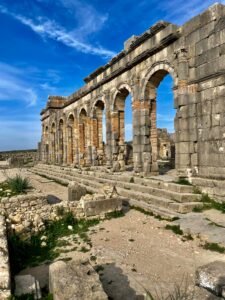
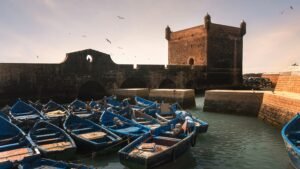
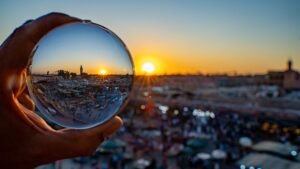
Ait Benhaddou is one of the most recognizable historic sites in southern Morocco and a must-see stop for travelers following the Road of the Kasbahs. This fortified ksar, built from earthen materials and set against the southern slopes of the High Atlas, is famous for its dramatic architecture, UNESCO World Heritage status, and appearances in major films and television productions. But Ait Benhaddou is more than a movie backdrop: it is a remarkable example of traditional southern Moroccan architecture and an important part of the historic caravan landscape.
In this guide, you will learn what makes Ait Benhaddou special, how it became associated with the film industry, what to see inside the ksar, how to get there from Marrakech or Ouarzazate, the best time to visit, and how to combine it with the Valley of the Roses, Dades Valley, Todra Gorge, and the Sahara Desert.SEO Rank Math Detail
What Is Ait Benhaddou?
Ait Benhaddou is a ksar, a fortified settlement made up of earthen buildings surrounded by defensive walls. It stands in the Ounila Valley in Ouarzazate Province, on the southern side of the High Atlas Mountains.
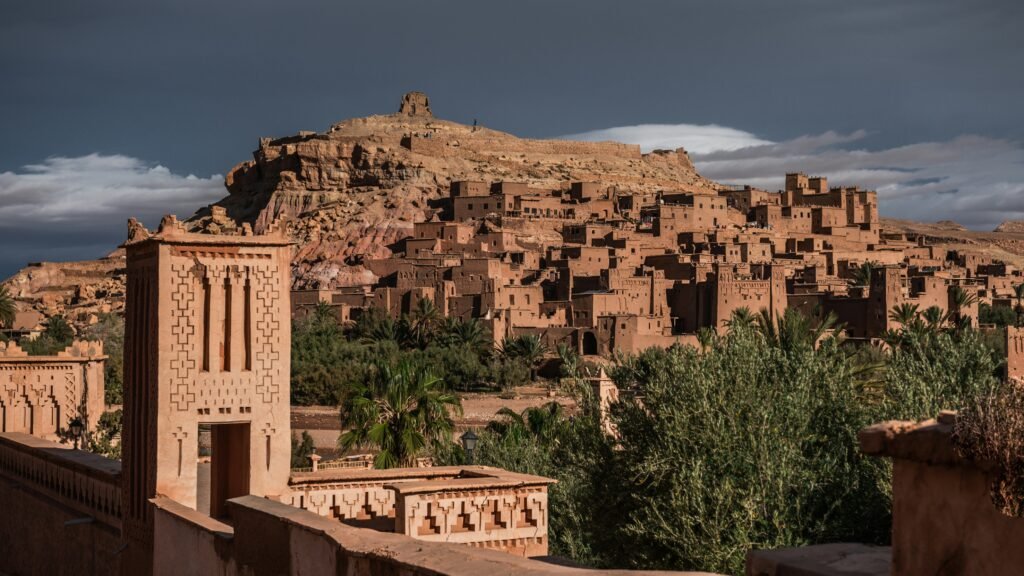
The word ksar refers to a fortified village or group of buildings, while kasbah generally describes a fortified residence or dwelling. Travelers often use the two terms interchangeably, but Ait Benhaddou is more accurately described as a ksar.
UNESCO inscribed the Ksar of Ait-Ben-Haddou on the World Heritage List in 1987, recognizing it as an outstanding example of southern Moroccan earthen architecture. Its compact buildings, defensive towers, communal areas, and traditional construction techniques illustrate the pre-Saharan architectural traditions of southern Morocco.
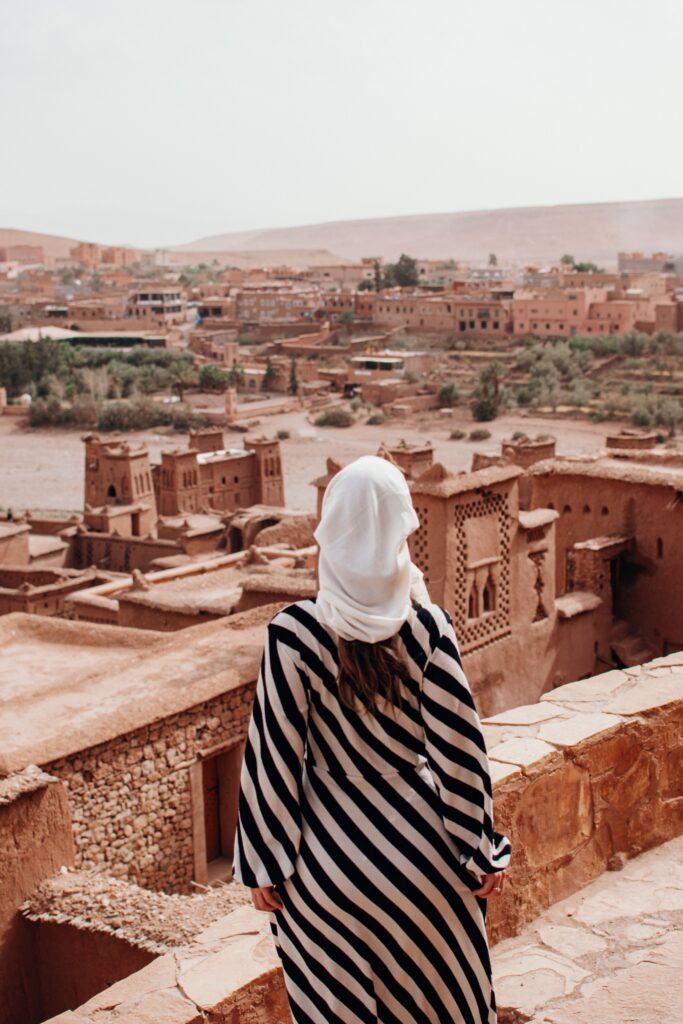
The settlement is especially impressive because of the way its buildings rise together on a hillside. Tall walls, corner towers, narrow passages, decorated façades, and traditional earth-and-wood construction create the distinctive appearance that has made the site internationally famous.
Why Is Ait Benhaddou Called a Film Studio City?
There is an important distinction for travelers: Ait Benhaddou itself is not a film studio. It is a historic fortified ksar that has been used as a filming location.
The nearby city of Ouarzazate is the center of Morocco’s film industry and is often described as the “Hollywood of Africa.” The region’s combination of desert landscapes, mountains, kasbahs, clear light, and historic-looking architecture has attracted international film productions for decades. The Moroccan National Tourist Office highlights Ouarzazate and its surrounding region as an important filming destination.
Ait Benhaddou became one of the region’s most recognizable natural film sets because very little scenery is needed to make the location look like an ancient city, desert kingdom, or fictional settlement.
Among the productions associated with Ait Benhaddou and the surrounding area are:
- Lawrence of Arabia
- Gladiator
- The Mummy
- Kingdom of Heaven
- Alexander
- Babel
- Prince of Persia
- Game of Thrones
The Moroccan National Tourist Office confirms the country’s long history of hosting major productions, including Gladiator, Babel, The Last Temptation of Christ, Inception, and Game of Thrones.
For film fans, this adds another layer to the visit. You can walk through the same type of narrow streets and gates that filmmakers have used to create fictional historical worlds. However, the real story of Ait Benhaddou is considerably older and more interesting than its Hollywood reputation.
The History Behind the Road of the Kasbahs
The area around Ait Benhaddou formed part of historic trading routes connecting the Sahara with cities to the north, including Marrakech.
UNESCO describes Ait Benhaddou as one of the important trading settlements along routes linking ancient Sudan with Marrakech through the Draa Valley and the Tizi-n’Telouet Pass.
This commercial history helps explain why fortified settlements became so important in southern Morocco. Caravans carrying goods across the Sahara needed places to stop, trade, rest, and protect themselves.
The surrounding landscape is often associated with the Road of a Thousand Kasbahs, particularly the route through the Dades Valley and the valleys east of Ouarzazate. It is not a single modern road with one fixed starting and ending point. Rather, the expression describes a spectacular region filled with fortified villages, kasbahs, palm oases, mountains, and traditional earthen architecture.
A journey along this route can include Ait Benhaddou, Ouarzazate, Skoura, the Valley of the Roses, Dades Valley, and Todra Gorge before continuing toward the Sahara.
For travelers, this is one of the most rewarding road-trip areas in Morocco because the attractions are not limited to individual monuments. The scenery between the stops is part of the experience.
What Makes Ait Benhaddou So Special?
Traditional Earthen Architecture
The first thing you notice at Ait Benhaddou is its color and texture.
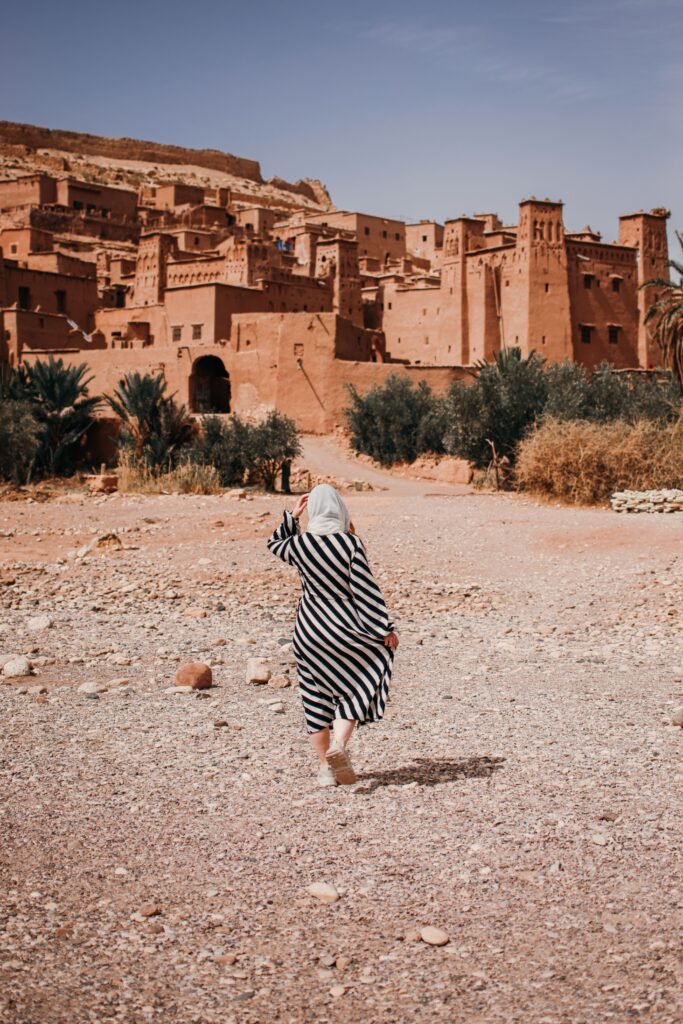
The buildings are made primarily from earth and other traditional materials, giving the settlement its warm reddish-brown appearance. Decorative motifs, towers, compact houses, and defensive walls create a strong visual connection between the architecture and the surrounding landscape.
UNESCO notes that the site retains much of its architectural authenticity, including the traditional use of earth and wood. At the same time, these materials are vulnerable to weathering and require regular maintenance and restoration.
This is one reason visitors should treat the site with care. Avoid climbing fragile walls, touching decorative surfaces unnecessarily, or entering restricted areas.
The Defensive Walls and Towers
Ait Benhaddou was designed as a fortified settlement. Its walls and towers helped protect the community and created a compact settlement that could be defended.
As you walk through the ksar, look beyond the most photographed façades. The architectural details become easier to appreciate when you notice how the houses, passages, towers, and communal spaces fit together.
The Hilltop View
One of the best reasons to walk toward the higher part of Ait Benhaddou is the panoramic view.
From above, the surrounding landscape opens toward the Ounila Valley and the dry mountain environment. The view also helps explain why the settlement was built in such a strategic-looking position.
For photography, early morning and late afternoon usually provide softer light and stronger contrasts across the earthen buildings.
What to See During Your Visit
Ait Benhaddou is not a place where you need to rush from one attraction to another. The pleasure comes from walking slowly through the settlement.
Here are the main things to look for.
1. The Main Entrance and Narrow Streets
Begin by walking toward the old fortified settlement and exploring its narrow passages. The transition from the modern surroundings into the historic ksar is part of the experience.
Take your time with the smaller architectural details. Doorways, walls, decorative patterns, and traditional construction techniques are often more interesting up close than they appear in photographs.
2. The Kasbah-Style Houses
Some structures are simple and functional, while others are more elaborate and resemble small fortified residences.
The contrast between different buildings shows that the ksar was not simply a collection of identical houses. UNESCO describes a mixture of modest dwellings and larger structures with towers and decorated upper sections.
3. The Communal Areas
The historic settlement includes communal spaces as well as residential buildings. UNESCO identifies features including a mosque, public square, grain-threshing areas, a caravanserai, cemeteries, and other community structures.
These elements are important because they show that Ait Benhaddou was a functioning community rather than a decorative collection of buildings.
4. The View From the Upper Area
If conditions allow, continue toward the higher part of the settlement for wider views of the valley.
Wear shoes with a reasonable grip because the paths can be uneven, and be particularly careful during hot weather.
How Long Do You Need at Ait Benhaddou?
For a basic visit, allow around 1.5 to 2.5 hours.
That gives you enough time to walk through the ksar, explore the architecture, take photographs, and enjoy the views without turning the visit into a rushed stop.
If you are interested in architecture, history, or photography, you may want longer.
The biggest mistake is treating Ait Benhaddou as a quick photo stop. Its compact size makes it easy to visit quickly, but slowing down allows you to understand why the site is important.
How to Get to Ait Benhaddou From Marrakech
Ait Benhaddou is a popular destination on trips between Marrakech and southern Morocco.
The journey from Marrakech takes you across the High Atlas Mountains, normally via the Tizi n’Tichka pass, before descending toward Ouarzazate and the Ounila Valley.
A private tour is particularly convenient because the route includes several places worth stopping at along the way. Depending on the itinerary, travelers can combine Ait Benhaddou with the Atlas Mountains, Telouet, Ouarzazate, Dades Valley, or the Sahara.
For travelers who want to combine the kasbah with the desert, our 3 Days From Marrakech desert tour includes Ait Benhaddou before continuing toward Dades, Todra Gorge, and Merzouga.
If you have more time, a longer itinerary allows you to experience the Road of the Kasbahs without spending most of the day inside a vehicle. Our 5 Days From Marrakech tour includes Ait Benhaddou, Ouarzazate, Skoura, the Valley of the Roses, Dades Valley, Todra Gorge, and the Erg Chebbi dunes.
How to Visit Ait Benhaddou From Ouarzazate
Ouarzazate is one of the easiest bases for visiting Ait Benhaddou.
The two destinations are close enough to combine in a single day, making Ouarzazate a practical stop for travelers exploring southern Morocco.
A good day can include:
- Ait Benhaddou in the morning
- Lunch in or around the village
- Ouarzazate in the afternoon
- A visit to one of the city’s film studios
- Taourirt Kasbah
- An overnight stay in Ouarzazate
This combination works especially well for travelers interested in both Moroccan architecture and cinema.
Ouarzazate’s film studios are genuine working film-set attractions, while Ait Benhaddou provides the opportunity to experience an authentic historic ksar that has also been used by filmmakers. The Moroccan National Tourist Office specifically highlights the Atlas Studios and other studios in Ouarzazate as major parts of the region’s film heritage.
Exploring the Road of the Kasbahs
Ait Benhaddou becomes even more impressive when included in a wider road trip.
After visiting the ksar, continue toward Ouarzazate and then explore the landscapes east of the city.
Ouarzazate
Known for its film industry, Ouarzazate is an excellent stop between Marrakech and the desert.
The city offers access to film studios, Taourirt Kasbah, and routes leading toward the Draa Valley and the Dades region.
Skoura
Skoura is famous for its palm oasis and traditional kasbahs. The contrast between green palm groves and the surrounding dry landscape makes it an excellent photography stop.
One of the region’s best-known monuments is Kasbah Amridil.
Valley of the Roses
The Valley of the Roses becomes especially interesting in spring, when rose cultivation and local rose products become a major part of the area’s identity.
Kelaat M’Gouna is a popular stop for travelers interested in rosewater, cosmetics, and local products.
Dades Valley
The Dades Valley is one of the most scenic sections of the Road of the Kasbahs. The road passes through dramatic rock formations, green valleys, villages, and numerous earthen kasbahs.
It is worth spending at least one night in the region rather than trying to see everything in a single afternoon.
Todra Gorge
Further east, Todra Gorge offers a completely different landscape. Huge rock walls rise around the valley, creating one of southern Morocco’s most spectacular natural attractions.
A short walk through the gorge can easily be combined with a Road of the Kasbahs itinerary before continuing toward Merzouga.
Ait Benhaddou and the Sahara Desert
One of the most popular ways to experience Ait Benhaddou is to combine it with a Sahara desert tour.
The logic of the route is simple: travel south from Marrakech across the High Atlas, explore Ait Benhaddou and Ouarzazate, continue through the kasbah country and gorges, and eventually reach the dunes around Merzouga.
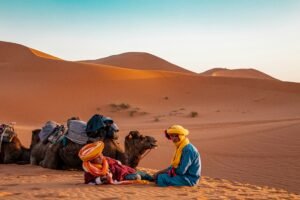
From there, travelers can experience a camel ride, sunset over Erg Chebbi, a desert camp, and sunrise in the dunes.
Travelers coming from Fes can make the journey in the opposite direction. Our 5 Days From Fes to Marrakech tour crosses the Atlas Mountains and Sahara region before finishing with Ait Benhaddou and the journey toward Marrakech.
For travelers beginning in Casablanca, a longer itinerary can also incorporate the desert, kasbahs, gorges, and Ait Benhaddou. Our 4 Days From Casablanca desert tour includes the Dades Valley, Ouarzazate, Ait Benhaddou, and the route toward Marrakech.
Best Time to Visit Ait Benhaddou
The most comfortable periods for exploring Ait Benhaddou are generally spring and autumn, when daytime temperatures are usually more manageable than during the hottest part of summer.
Summer can be very hot in southern Morocco, especially when walking around exposed earthen buildings with limited shade.
Winter brings cooler mornings and evenings, particularly after sunset. Daytime sightseeing can still be pleasant, but bring layers if you are traveling during the colder months.
For photography, consider visiting early in the morning or later in the afternoon. The lower-angle sunlight can bring out the texture and color of the earthen walls.
Practical Tips for Visiting Ait Benhaddou
Wear Comfortable Shoes
The historic settlement has uneven surfaces, steps, slopes, and narrow paths. Comfortable walking shoes are much more useful than fashionable footwear.
Carry Water
Southern Morocco can be hot and dry. Bring water, especially during warmer months.
Bring Sun Protection
A hat, sunglasses, and sunscreen are useful because parts of the route are exposed to direct sunlight.
Allow Extra Time for Photography
Ait Benhaddou is one of those destinations where you can easily spend longer than expected taking photographs. Give yourself enough time rather than squeezing the visit between two rushed stops.
Respect the Historic Buildings
The site is protected heritage. Avoid climbing fragile structures or touching decorative surfaces unnecessarily.
UNESCO notes that the earthen buildings are particularly vulnerable and require ongoing maintenance and conservation.
Consider a Local Guide
A guide can add valuable context about the architecture, historic caravan routes, local traditions, and filming history. Without context, it is easy to see Ait Benhaddou simply as a beautiful collection of brown buildings.
Is Ait Benhaddou Worth Visiting?
Yes, especially if your Morocco itinerary already includes Marrakech, Ouarzazate, the High Atlas Mountains, or the Sahara.
The site combines several experiences in one location: UNESCO-listed heritage, traditional Moroccan architecture, caravan-route history, dramatic mountain scenery, and international film history.
Its location is also part of its appeal. Ait Benhaddou is not an isolated attraction that requires a special journey across the country. It fits naturally into a southern Morocco itinerary linking Marrakech with Ouarzazate, the Dades Valley, Todra Gorge, and the Sahara.
For travelers interested in cinema, it is an opportunity to see a real filming location. For history enthusiasts, it is a preserved example of pre-Saharan earthen architecture. And for photographers, the combination of red-earth buildings, mountains, valley landscapes, and changing light makes it one of the most photogenic places in Morocco.
Frequently Asked Questions About Ait Benhaddou
Is Ait Benhaddou a film studio?
No. Ait Benhaddou is a historic fortified ksar and UNESCO World Heritage Site that has been used as a filming location. The main film studios are located in nearby Ouarzazate.
What movies were filmed at Ait Benhaddou?
Ait Benhaddou and the surrounding Ouarzazate region have been used for productions including Gladiator, Lawrence of Arabia, Kingdom of Heaven, The Mummy, Babel, Alexander, and Game of Thrones. Different productions used different locations in the wider region, so not every title associated with Ouarzazate was filmed entirely inside Ait Benhaddou.
Is Ait Benhaddou a UNESCO World Heritage Site?
Yes. The Ksar of Ait-Ben-Haddou was added to the UNESCO World Heritage List in 1987 under criteria related to architectural achievement and traditional settlement.
How long should I spend at Ait Benhaddou?
Around two hours is a good starting point for most visitors. Travelers interested in photography, architecture, or history may prefer to spend longer.
Can I visit Ait Benhaddou from Marrakech?
Yes. Ait Benhaddou is commonly visited during journeys from Marrakech toward Ouarzazate and the Sahara. A private multi-day tour is a convenient option because you can combine the ksar with the High Atlas, Ouarzazate, Dades Valley, Todra Gorge, and Merzouga.
Can I visit Ait Benhaddou and the Sahara on the same trip?
Absolutely. Combining Ait Benhaddou with the Sahara is one of the best ways to explore southern Morocco. The route can include Ouarzazate, the Road of the Kasbahs, Dades Valley, Todra Gorge, and Merzouga before returning to Marrakech or continuing to Fes.
What should I wear when visiting Ait Benhaddou?
Wear comfortable walking shoes and light, breathable clothing. Sun protection is important, particularly in summer. A light layer is useful during cooler mornings and evenings in winter.
Ait Benhaddou is much more than a famous movie backdrop: it is a UNESCO-listed ksar, a remarkable example of southern Moroccan earthen architecture, and one of the highlights of the Road of the Kasbahs. Combining it with Ouarzazate, the Valley of the Roses, Dades Valley, Todra Gorge, and the Sahara turns a simple sightseeing stop into a complete southern Morocco journey. If you want to explore Ait Benhaddou with comfortable transport, local expertise, and an itinerary tailored to your travel plans, explore the Morocco Best Tour itineraries and plan your private Morocco adventure.