If you are planning a trip to Morocco, you may have seen the words djellaba and kaftan while shopping in the souks or researching traditional Moroccan clothing. Although both are important parts of Moroccan dress, they are not the same garment. The main difference is that a djellaba is a practical, loose-fitting robe with a hood, commonly worn by both men and women, while a Moroccan kaftan is generally a more elegant, decorative garment associated especially with women’s formal occasions.
Understanding the difference can make shopping in Morocco much easier. In this guide, you will learn what each garment looks like, when Moroccans wear it, how much formality to expect, what fabrics and details to look for, and which one makes the most practical souvenir for your trip.
What Is a Djellaba?
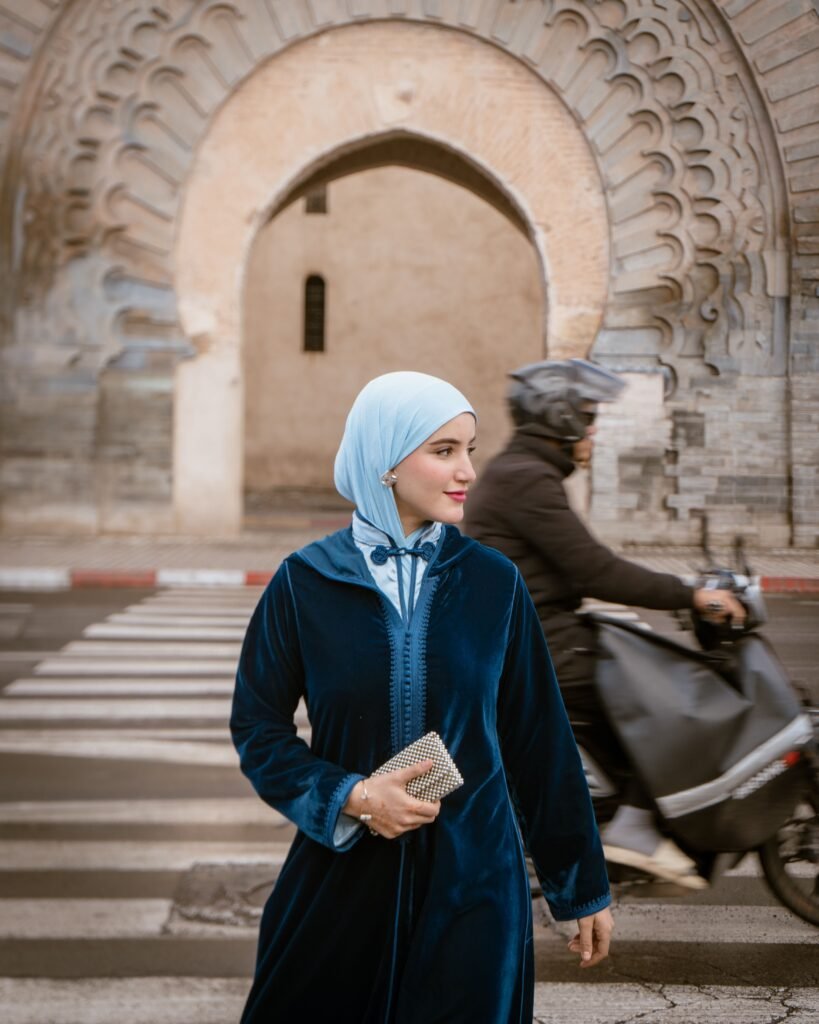
A djellaba, also spelled jellaba or djellabah, is one of the most recognizable traditional garments in Morocco. It is a long, loose-fitting robe designed to cover most of the body and usually features long sleeves and a distinctive hood called a qob.
Djellabas are worn by both men and women, although the cut, fabric, colors, and decoration can vary. You will see them in cities, villages, mountain regions, and rural areas, and they are particularly easy to notice when walking through traditional neighborhoods and medinas.
The djellaba is not simply a costume for visitors. It remains part of everyday Moroccan clothing, although many people also wear modern Western-style clothes depending on their work, age, location, and personal preference.
Why Does a Djellaba Have a Hood?
The hood is one of the easiest ways to distinguish a djellaba from many other Moroccan garments.
The hood has a practical purpose. It can provide protection from sun, wind, dust, and cooler temperatures. This is particularly useful in Morocco, where temperatures can change considerably between daytime and evening and between different regions.
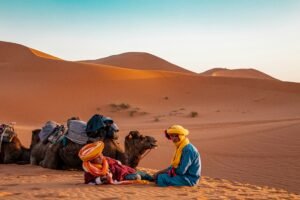
In the Sahara and other dry areas, loose clothing can also be more comfortable than tight-fitting garments because it allows air to circulate while providing protection from strong sunlight.
What Does a Djellaba Look Like?
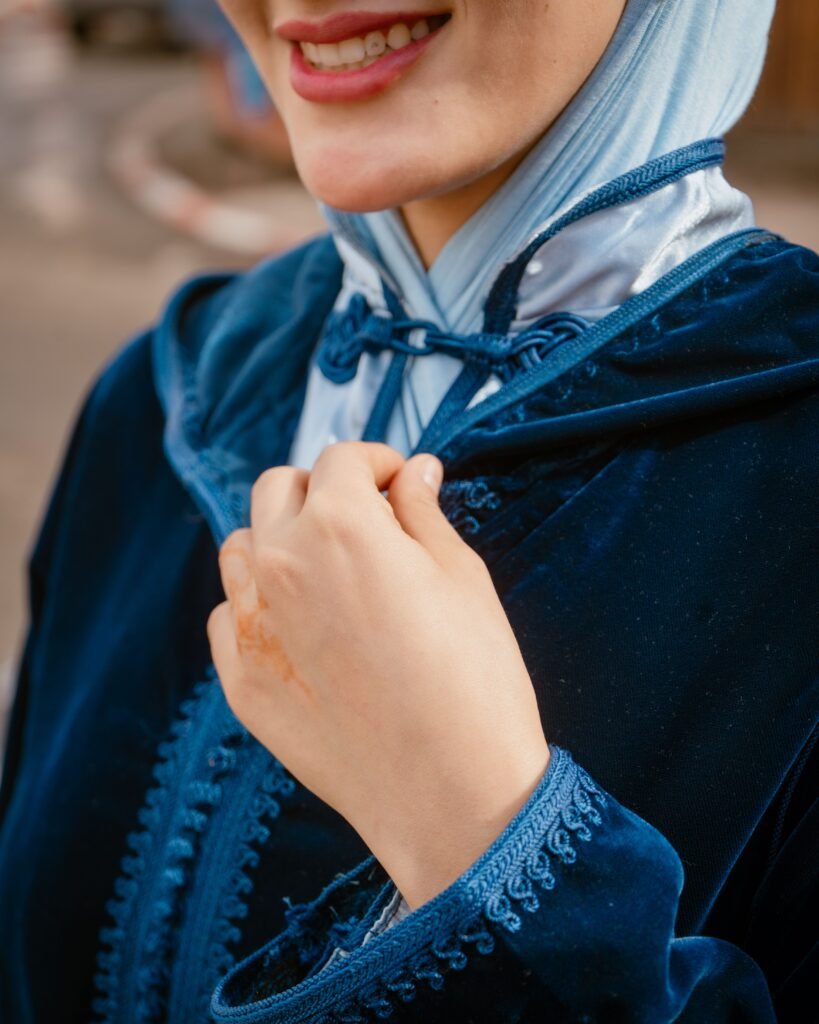
Traditional djellabas are generally:
- Long and loose-fitting
- Full-length or close to the ankles
- Made with long sleeves
- Designed with a hood
- Available in simple or highly decorated styles
- Made from different fabrics depending on the season
- Worn by both men and women
For everyday use, a djellaba may be relatively simple. For special occasions, it can feature embroidery, decorative stitching, high-quality fabrics, or more elaborate finishing.
Men’s djellabas are often seen in neutral, white, beige, grey, brown, or darker shades, although modern styles come in many colors. Women’s djellabas can be much more varied and decorative.
What Is a Moroccan Kaftan?
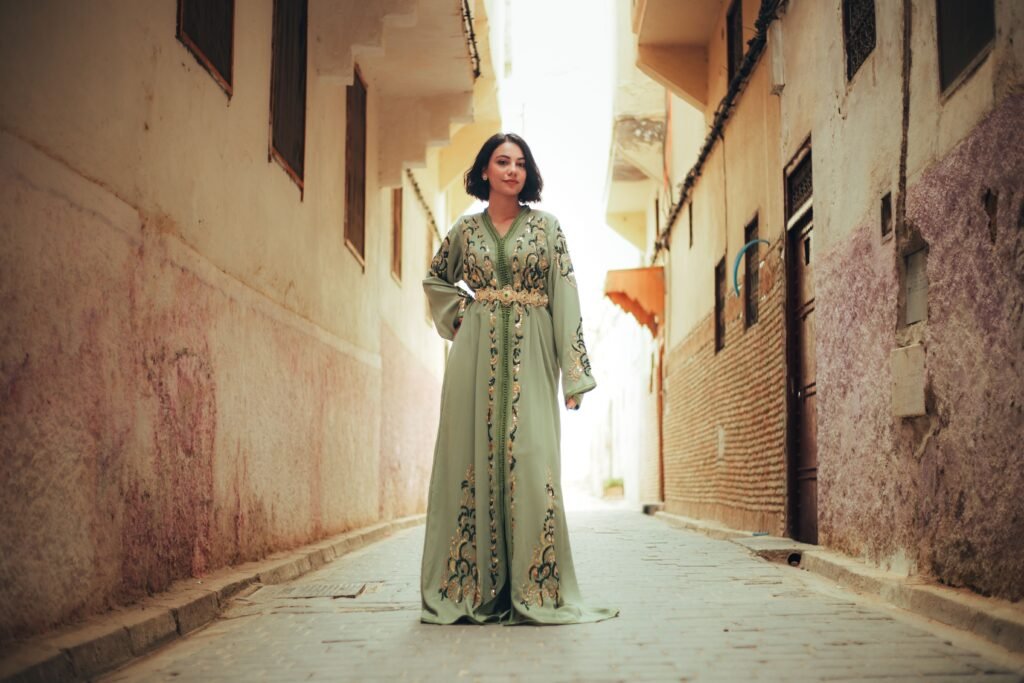
The Moroccan kaftan is a long, elegant garment strongly associated with women’s formal and ceremonial clothing. It is especially common at weddings, celebrations, family occasions, and other important events.
Unlike the djellaba, a traditional Moroccan kaftan normally does not have a hood. It is often more fitted or shaped around the body and can feature elaborate embroidery, decorative buttons, metallic thread, beads, sequins, or other forms of craftsmanship.
The word kaftan itself has a much wider history across different regions, so it is important not to assume that every garment called a kaftan looks Moroccan. When people talk about a Moroccan kaftan, they are generally referring to a distinctive style that has developed within Morocco’s clothing traditions.
Moroccan Kaftan vs Takchita
Travelers sometimes encounter another term: takchita.
A Moroccan takchita is generally a more elaborate, layered formal outfit. It may consist of an underdress and an outer layer, often accompanied by a belt called a mdamma. The terms can sometimes be used loosely in shops, especially for modern fashion, but a traditional Moroccan kaftan and a takchita are not necessarily identical.
If you are shopping for formal Moroccan clothing, ask the seller to explain the construction and intended use rather than relying only on the label.
Djellaba vs Kaftan: The Main Differences
The easiest way to understand the difference is to compare their purpose, design, and typical use.
| Feature | Djellaba | Moroccan Kaftan |
| Main purpose | Everyday wear and practical traditional clothing | Formal, ceremonial and elegant wear |
| Hood | Usually yes | Usually no |
| Fit | Loose and flowing | Often more shaped and decorative |
| Typical wearers | Men and women | Traditionally associated especially with women |
| Formality | Everyday to semi-formal | Usually formal |
| Decoration | Simple to elaborate | Often highly decorated |
| Common occasions | Daily life, religious occasions, cooler weather | Weddings, celebrations and special events |
| Practicality for travel | High | More limited for everyday sightseeing |
The important point is that these garments should not be viewed simply as two versions of the same outfit. They have different roles within Moroccan dress culture.
Djellaba vs Kaftan: Which One Is More Traditional?
Both are traditional Moroccan garments, but they represent different aspects of Moroccan clothing.
The djellaba is closely connected with everyday life. If you walk through a Moroccan medina early in the morning, visit a local market, or travel through smaller towns, you may see people wearing djellabas as part of normal daily life.
The kaftan is more closely associated with elegance, celebration, craftsmanship, and formal occasions. Its decorative details can require considerable work, particularly when it is handmade or produced by skilled artisans.
For a traveler interested in seeing Moroccan clothing in an authentic setting, it is useful to remember that traditional dress is not limited to one fixed style. Clothing changes with region, season, occasion, generation, and personal taste.
When Do Moroccans Wear a Djellaba?
A djellaba can be worn in many different situations.
Everyday Life
Simple djellabas are practical garments for daily use. In traditional neighborhoods and smaller communities, you may see them regularly.
Religious and Cultural Occasions
Djellabas may also be worn during religious celebrations and other important cultural occasions. A person may choose a cleaner, newer, or more formal djellaba for such events.
Cooler Weather
A heavier djellaba can be particularly useful during cooler months. In mountainous areas, evenings can be cold even when the daytime is pleasant.
If you are visiting Morocco during spring, autumn, or winter, you may notice more substantial djellabas designed to provide warmth.
When Is a Moroccan Kaftan Worn?
A kaftan is usually chosen when the occasion calls for something more formal.
Moroccan Weddings
Weddings are one of the best-known occasions for elaborate Moroccan clothing. A bride or wedding guest may wear beautifully decorated traditional garments, with several outfit changes possible during a celebration.
Family Celebrations
Kaftans may also be worn for engagements, religious celebrations, parties, and important family gatherings.
Formal Events
Some modern Moroccan designers have adapted the traditional kaftan into contemporary fashion. These versions can combine traditional embroidery and construction with modern cuts, fabrics, and colors.
For travelers, this means you may see everything from very traditional garments to sophisticated fashion pieces inspired by Moroccan heritage.
Which Is Better for Travelers: Djellaba or Kaftan?
For most travelers, the djellaba is the more practical choice.
If your goal is to buy something you can actually wear during your Morocco trip, a lightweight djellaba is generally easier to use. Its loose shape makes it comfortable for walking around medinas, visiting markets, relaxing at a riad, or enjoying cooler evenings.
A kaftan makes more sense if you are looking for a special souvenir, attending a Moroccan celebration, or interested in traditional fashion and craftsmanship.
The right choice also depends on the climate and your itinerary.
If you are spending time in Marrakech during warm weather, look for a lightweight cotton or breathable fabric. If you are heading into the Atlas Mountains or traveling during cooler months, a heavier fabric can be more useful.
If your itinerary includes the Sahara, remember that desert temperatures can vary sharply between day and night. A lightweight garment may be comfortable during the day, while something warmer is useful after sunset.
Travelers interested in combining Moroccan culture with the desert can explore the Marrakech tours and Sahara itineraries offered by Morocco Best Tour when planning their route.
Can Tourists Wear a Djellaba in Morocco?
Yes. Tourists can wear a djellaba, and it can be a fun way to connect with Moroccan clothing traditions.
However, there is an important difference between wearing traditional clothing respectfully and treating it as a costume.
If you buy a djellaba and wear it while exploring Morocco, choose one that is comfortable and appropriate for the setting. You do not need to imitate a particular local style. Simply wearing the garment naturally and respectfully is enough.
A djellaba can also be useful when visiting religious or conservative environments because its loose, full-length design provides greater coverage than typical Western summer clothing.
That said, a djellaba is not a substitute for understanding local etiquette. Clothing expectations can vary depending on where you are visiting, so it is still sensible to dress modestly in traditional neighborhoods and religious settings.
Where Can You Buy a Djellaba or Kaftan in Morocco?
Traditional clothing is widely available in Moroccan medinas and souks. Marrakech, Fes, Meknes, Rabat, and other historic cities all have shops selling traditional garments.
You will find a wide range of quality levels.
Some garments are factory-produced and intended mainly for visitors, while others are made by local tailors or artisans. Prices can vary considerably depending on fabric, construction, embroidery, brand, and workmanship.
Tips for Buying a Djellaba
Before purchasing, check:
- The fabric and weight
- Stitching quality
- Sleeve length
- Hood construction
- Overall comfort
- Whether the garment is washable
- Whether the size allows comfortable movement
Try the djellaba on before buying it. A garment that looks excellent on a hanger may feel too long, too wide, or uncomfortable once you walk around.
Tips for Buying a Kaftan
With a kaftan, pay particular attention to:
- Embroidery quality
- Decorative stitching
- Buttons and closures
- Fabric weight
- Lining
- Finishing around the neckline and sleeves
- How the garment sits when worn
If the kaftan is heavily decorated, inspect the details closely. Loose threads, uneven embroidery, or poorly attached decorations may indicate lower-quality workmanship.
How Much Should You Pay for a Djellaba or Kaftan?
There is no single fixed price because Moroccan traditional clothing ranges from inexpensive ready-made pieces to high-end handmade garments.
A simple djellaba designed for everyday use can be relatively affordable. Handmade pieces using better fabrics and detailed embroidery can cost substantially more.
Kaftans usually have an even wider price range because formal garments can involve extensive decoration and craftsmanship.
When shopping in a souk, do not judge a garment only by its starting price. Compare several shops, inspect the quality, and consider how much you actually value the craftsmanship.
If you are buying a garment as a serious souvenir, it can be worth paying more for better construction rather than choosing the cheapest option.
Is a Djellaba Good for a Morocco Desert Tour?
Yes, particularly if you choose the right fabric and weight.
A loose djellaba can be comfortable in dry conditions and provides useful coverage from the sun. The hood can also help protect your head from wind and dust.
However, do not assume that a djellaba alone is enough for every desert condition. Bring practical layers, especially if you are traveling outside the hottest part of summer.
For example, on a Sahara trip you may want:
- Breathable clothing for daytime
- A warm layer for the evening
- Comfortable walking shoes
- Sunglasses
- Sun protection
- A scarf or head covering
- A light jacket during cooler seasons
Morocco Best Tour’s 5-day Marrakech to Fes desert tour includes the Erg Chebbi dunes, camel trekking and an overnight desert camp, making this type of journey a good opportunity to experience the contrast between Morocco’s cities and Sahara landscapes.
For travelers with more time, a 7-day Morocco tour from Marrakech also combines Marrakech with the High Atlas, Ait Ben Haddou, Ouarzazate, the Dades region and the desert.
Is a Kaftan Practical for Sightseeing?
Usually, no.
A formal kaftan is designed for appearance and special occasions rather than long days of walking. Heavy fabrics, detailed embroidery, decorative elements, and a more fitted shape can make it less convenient for exploring Morocco’s medinas or spending hours in a vehicle.
If you love Moroccan fashion, however, there is nothing wrong with buying one as a special souvenir.
A lighter modern kaftan can also be more versatile than a heavily decorated ceremonial version.
The key is to choose the garment according to how you plan to use it.
Djellaba or Kaftan: Which Makes the Better Souvenir?
For a practical souvenir, choose a djellaba.
For a statement piece of Moroccan fashion, choose a kaftan.
A djellaba is generally easier to wear at home, especially if you choose a simple design in a neutral color. It can become a comfortable robe or distinctive piece of clothing rather than something that stays in the back of a wardrobe.
A kaftan can be the better choice if you appreciate textile craftsmanship, embroidery, and formal clothing. It can also make a memorable gift, particularly when you know the recipient’s size and style.
Another option is to buy smaller traditional textile products if you are unsure about clothing sizes.
Cultural Etiquette When Wearing Traditional Moroccan Clothing
A little cultural awareness goes a long way.
Morocco is a diverse country, and traditional clothing varies between regions and communities. Avoid assuming that one style represents every Moroccan.
When taking photographs, always ask permission before photographing people, especially in markets or rural communities. Wearing traditional clothing does not give you permission to photograph someone simply because they are dressed traditionally.
If you visit a mosque or religious site where non-Muslims are permitted to enter, follow the site’s specific clothing and photography rules.
Most importantly, enjoy the clothing as part of Moroccan culture rather than presenting it as a costume. A respectful approach makes the experience more meaningful.
FAQ: Djellaba vs Kaftan
Is a djellaba the same as a kaftan?
No. A djellaba is generally a loose, long robe with a hood and is worn by both men and women. A Moroccan kaftan is usually a more decorative and formal garment, particularly associated with women’s traditional clothing.
Do men wear kaftans in Morocco?
Men have historically worn kaftan-style garments in parts of the broader Islamic world, and men’s traditional Moroccan clothing includes several related styles. In contemporary Morocco, however, the word “kaftan” is especially associated with women’s formal fashion, while the djellaba is commonly worn by men.
Do women wear djellabas?
Yes. Women in Morocco also wear djellabas, ranging from simple everyday versions to highly decorated garments for special occasions.
Can tourists wear a djellaba?
Yes. Tourists can wear djellabas in Morocco. Choose a comfortable garment and wear it respectfully rather than treating traditional clothing as a costume.
Is a djellaba good for hot weather?
A lightweight djellaba made from breathable fabric can be comfortable in warm, dry weather. For very hot conditions, choose light colors and breathable materials rather than heavy fabrics.
Is a kaftan only worn at weddings?
No. Weddings are an important occasion for wearing Moroccan kaftans, but they can also be worn at engagements, religious celebrations, family events, parties, and other formal occasions.
What is the difference between a Moroccan kaftan and a takchita?
A kaftan is generally a single long formal garment, while a takchita is commonly a layered outfit with an underdress and outer layer. The terms can be used somewhat loosely in modern fashion, so asking a local tailor or seller about the construction is useful.
Should I buy a djellaba in Marrakech or Fes?
Both cities are good places to shop for traditional clothing. Marrakech is particularly convenient for travelers exploring the medina and souks, while Fes is also renowned for traditional crafts and its historic medina. Quality and price vary by shop, so compare garments rather than choosing based only on the city.
What should I wear under a djellaba?
Wear comfortable, breathable clothing underneath. In warm weather, lightweight trousers or a long skirt with a simple shirt can work well. During cooler months, add layers that allow you to adjust your clothing as temperatures change.
The simplest way to remember the difference is this: a djellaba is a practical, hooded Moroccan robe commonly worn by both men and women, while a kaftan is generally a more elegant, decorative garment associated with formal occasions and especially women's fashion. If you want a useful piece of clothing during your trip, a lightweight djellaba is the better choice; if you want an impressive traditional fashion souvenir, a kaftan may be ideal. To experience the culture, landscapes, and cities where these traditions come to life, contact Morocco Best Tour to plan a personalized Moroccan journey.